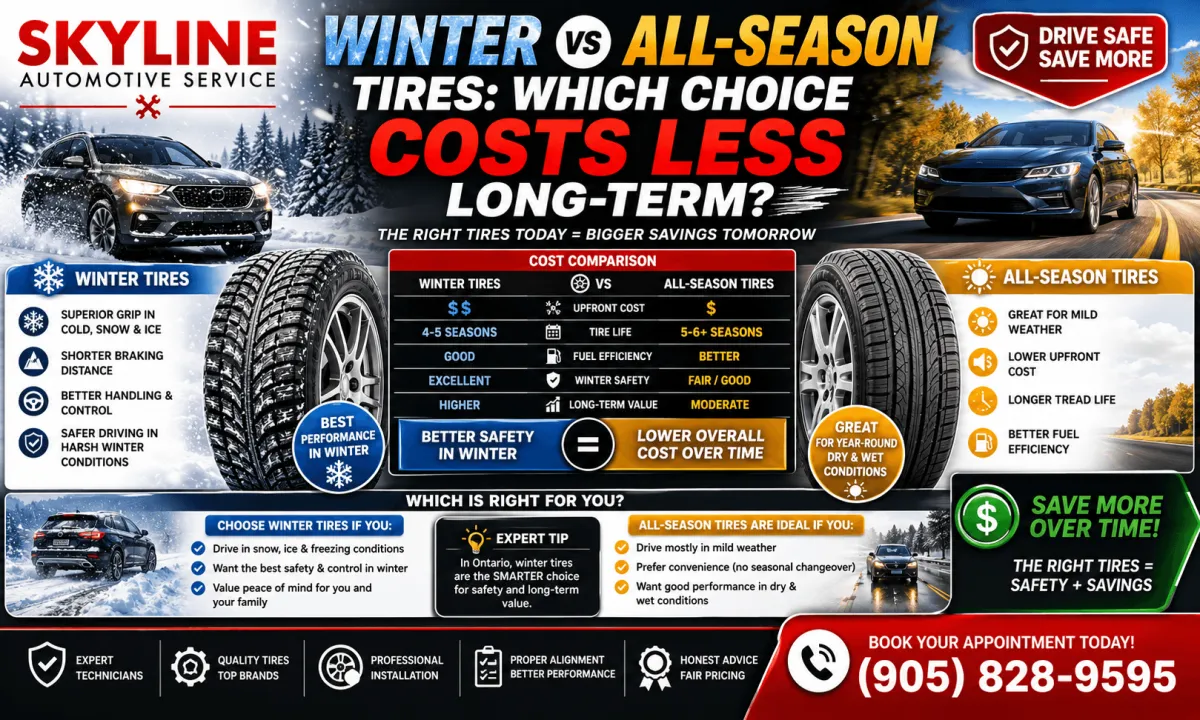
Winter vs All-Season Tires: Which Choice Costs Less Long-Term?
Every fall, drivers across Mississauga, ON face the same decision: stick with all-season tires year-round, or invest in a dedicated set of winter tires and swap them twice a year. The upfront case for all-seasons seems obvious — one set of tires, no seasonal swaps, no extra storage costs. But when you run the actual numbers and factor in safety, tire longevity, and the realities of Ontario winters, the long-term financial picture tells a more nuanced story.
This comparison is designed to give you an honest, numbers-grounded answer to a question most shops will have a vested interest in answering only one way.
What Makes Winter and All-Season Tires Different
The core difference between winter and all-season tires is not primarily about tread pattern — it is about the rubber compound. Winter tires are made from a specialized rubber compound that remains flexible in temperatures below 7 degrees Celsius. All-season tires use a harder compound designed for performance across a wider range of temperatures, but one that stiffens significantly in cold weather.
When the temperature in Mississauga, ON drops to the typical January and February range, all-season tires are operating outside their optimal temperature range. The rubber is stiffer, which means grip is reduced — particularly on snow, ice, and cold wet pavement. Winter tires, because they stay pliable, maintain grip that is measurably superior under these conditions.
The tread patterns are also meaningfully different. Winter tires feature deep directional grooves, siping patterns (tiny cuts in the tread blocks), and open shoulder designs that evacuate snow and slush, bite into loose snow, and channel water efficiently. All-season tread is a compromise — good enough in most conditions, but not optimized for any single one.
The Cost Breakdown: Winter Tires vs. All-Seasons
Here is a realistic cost comparison for a typical passenger vehicle — a mid-size sedan or SUV — over a five-year ownership period, which represents approximately two sets of all-season tires or one set of winter plus one set of all-seasons on separate rims.
The cost difference over five years is relatively modest — often within a few hundred dollars either way depending on your specific tires, storage situation, and insurer. The insurance discount alone (which Ontario insurers are required to offer for winter tires) can close a significant portion of that gap.
Where the Real Value of Winter Tires Shows Up
The financial comparison above does not capture the full picture. Here is what the spreadsheet misses.
Tire Longevity
When you run two sets of tires seasonally, each set accumulates roughly half the annual kilometres. A set of all-seasons driving year-round might cover 25,000 kilometres per year and need replacement every three to four years. A set of all-seasons driven only in spring, summer, and fall covers approximately 15,000 to 18,000 kilometres annually and may last five to seven years. Your winter tires similarly last longer because they are not being used in warmer weather that is harder on their softer compound. You are spreading the wear across two sets, effectively getting more total kilometres from your tire budget.
Accident Avoidance
Stopping distance tests in real winter conditions consistently show winter tires stopping a vehicle 25 to 40 percent shorter than all-seasons on snow and ice. In Mississauga, ON, where winter driving involves highway merges, traffic circles, and rapid weather changes off Lake Ontario, that stopping distance difference is not an abstract statistic — it is the difference between a near miss and a collision. The cost of an at-fault collision — including deductibles, premium increases, and lost no-claims discounts — can easily exceed $3,000 to $5,000 over the years that follow.
Vehicle Control and Stress
Winter tires do not just improve stopping — they improve steering response on ice, acceleration traction in snow, and overall vehicle stability. Drivers who make the switch frequently report that winter driving feels entirely different — less reactive and stressful, more controlled. That reduction in close calls and stress is real, even if it does not show up on a cost spreadsheet.
What Ontario Law and Insurers Say
Ontario does not legally mandate winter tires for most passenger vehicles, unlike Quebec which has had a requirement since 2008. However, Ontario insurers are legally required to offer a discount to policyholders who use winter tires on all four wheels. The discount varies by insurer but typically ranges from 2 to 5 percent of the premium. For drivers in Mississauga, ON paying average insurance rates, this can represent $50 to $150 or more in annual savings — directly offsetting changeover costs.
It is also worth noting that insurance coverage in the event of a winter accident can be affected by demonstrable negligence in vehicle preparedness. While this is a complex area of claims law, driving on tires that are visibly inappropriate for winter conditions is the kind of factor that can come up in the course of an investigation.
Frequently Asked Questions
Do I need four winter tires or can I use two on the drive wheels?
Always install four winter tires. Fitting winter tires only on the drive wheels creates a dangerous imbalance — the end with better grip will behave very differently from the end without it. On a front-wheel drive vehicle, rear all-seasons will lose traction in cornering. On a rear-wheel drive vehicle, front all-seasons will understeer severely. Four matched winter tires is the only safe and effective configuration.
At what temperature should I switch to winter tires?
The technical answer is 7 degrees Celsius — the temperature below which all-season rubber begins to compromise grip. In practical terms for Mississauga, ON, this means making the switch in October or early November before the first hard cold snap, and switching back in April once nighttime temperatures are consistently above 7 degrees.
Are all-weather tires a legitimate middle ground?
All-weather tires — which carry the Three-Peak Mountain Snowflake (3PMSF) certification — are a step up from standard all-seasons in winter performance. They use a compound that remains more flexible in cold temperatures and a tread pattern with more winter capability. They are not the equal of dedicated winter tires in severe snow and ice conditions, but they are a reasonable choice for drivers who genuinely cannot manage seasonal swaps. They typically qualify for the Ontario insurance discount.
How do I store my winter tires in the off-season?
Tires should be stored in a cool, dry location away from direct sunlight, ozone sources (such as electric motors), and petroleum products. If stored unmounted, stack them flat or hang them. If stored mounted on rims, stand them upright and rotate their position periodically. Many shops in Mississauga, ON offer seasonal tire storage for a modest fee, which is convenient for drivers without suitable storage space.
How do I know when my winter tires need to be replaced?
Winter tires have a specific wear indicator and should generally be replaced when tread depth reaches 4/32 of an inch — twice the minimum for all-season tires — because their winter performance degrades significantly as tread depth decreases. Most winter tires also have a practical lifespan of five to seven seasons regardless of tread depth, as the rubber compound hardens over time and loses its cold-weather flexibility. Check the date code on the sidewall (a four-digit number indicating the week and year of manufacture) if you are uncertain about the age of a used set.
Conclusion
The winter versus all-season debate is genuinely close on pure cost grounds — the five-year totals are often within a few hundred dollars of each other. But when you factor in the insurance discount, the extended life of two sets that share the annual mileage, and the very real cost of a winter collision that better tires might have prevented, the case for dedicated winter tires in Mississauga, ON is compelling.
Whether you are ready to make the switch to winters or want to talk through what makes sense for your vehicle, driving habits, and budget, the team at Skyline Automotive Service is happy to walk you through the options honestly. Book your seasonal tire service appointment today and get ahead of the first cold snap.
