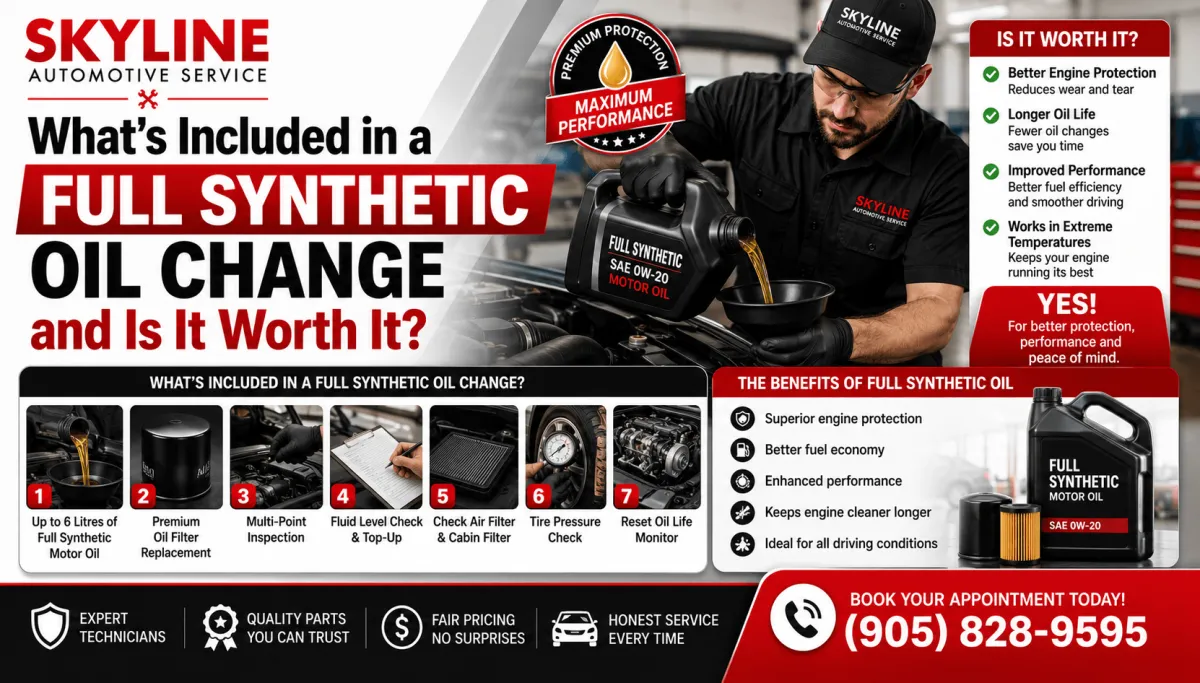
What's Included in a Full Synthetic Oil Change and Is It Worth It?
Walk into any oil change shop and you will face a choice: conventional, synthetic blend, or full synthetic. The price difference between conventional and full synthetic can be significant — often two to three times more per service. For drivers in Mississauga, ON trying to make a smart financial decision about routine maintenance, the question is legitimate: what are you actually getting with full synthetic oil, and does the premium justify the cost?
The answer is not as simple as the shop's upsell script suggests, but for the majority of modern vehicles, full synthetic oil is genuinely worth it — and in many cases it is not even a choice, it is a requirement.
What Full Synthetic Oil Actually Is
Motor oil starts as a base oil combined with a package of additives that control viscosity, prevent oxidation, reduce friction, and clean engine surfaces. The difference between conventional, synthetic blend, and full synthetic lies in the base oil.
Conventional motor oil is refined from crude oil. The refining process removes many impurities, but some remain, and the molecular structure of the base oil is irregular — meaning its performance can vary under temperature extremes. Synthetic blend oil combines conventional and synthetic base stocks, offering some improvement over conventional at a moderate price point.
Full synthetic oil is engineered at the molecular level. The base stock is either derived from natural gas through a Gas-to-Liquid (GTL) process, or built from synthesized compounds. The result is a uniform molecular structure that performs more consistently across a wider range of temperatures, maintains its viscosity better over time, and degrades more slowly than conventional oil.
What Is Included in a Full Synthetic Oil Change
A complete full synthetic oil change is more than just swapping out the fluid. Here is what a thorough service should include from start to finish.
Draining the old oil completely from the engine sump
Removing and replacing the oil filter with a new filter rated for the oil change interval
Refilling the engine with the correct volume and specification of full synthetic oil as stated in the owner's manual
Checking and topping up other fluid levels — coolant, brake fluid, power steering fluid, and windshield washer fluid
Inspecting belts, hoses, and visible engine components for obvious wear or leaks
Resetting the oil life monitor if the vehicle is equipped with one
Providing a sticker or documentation showing the date, mileage, and next recommended service interval
Any reputable shop performing this service in Mississauga, ON should complete all of these steps — not just the drain and fill.
The Real Advantages of Full Synthetic Oil
Full synthetic oil offers performance advantages that translate directly into engine longevity and cost savings over the life of a vehicle. Here are the benefits that have the most practical impact for drivers.
Better Protection in Extreme Temperatures
Ontario winters put real stress on engines. When temperatures drop well below zero, conventional oil thickens and flows slowly on startup — meaning the first few seconds after a cold start involve metal-on-metal contact before adequate lubrication reaches all engine components. Full synthetic oil flows significantly better at low temperatures, reducing that startup wear. On the other end, Mississauga, ON summer heat and stop-and-go traffic push oil temperatures high, and synthetic oil maintains its protective film thickness better than conventional under heat stress.
Longer Change Intervals
Full synthetic oil is engineered to resist oxidation and breakdown over a longer period. Most manufacturers that specify full synthetic oil allow intervals of 8,000 to 12,000 kilometres or more, compared to the 5,000-kilometre interval typically associated with conventional oil. Over a year of driving, you may need two oil changes with synthetic versus three or four with conventional — partially offsetting the higher per-change cost.
Cleaner Engine Internals
Synthetic oil contains more robust additive packages that do a better job of suspending combustion byproducts and carrying them to the filter, rather than allowing sludge to accumulate on internal engine surfaces. Engines that have run full synthetic consistently throughout their life typically show significantly less internal deposits when inspected.
Improved Fuel Economy
The lower internal friction produced by synthetic oil has a measurable, if modest, effect on fuel economy — typically in the range of one to two percent. Over tens of thousands of kilometres, that adds up to real savings at the pump.
Is Full Synthetic Worth the Cost in Mississauga, ON?
The cost difference between a conventional and full synthetic oil change typically ranges from $30 to $60 per service. Whether that premium is worth it depends on several factors.
If your vehicle's owner's manual specifies full synthetic oil, the decision is made for you — using a lower grade oil voids your warranty and can cause engine damage. Many European vehicles, performance models, and newer North American vehicles fall into this category.
If your vehicle does not require synthetic but you drive in demanding conditions — cold Ontario winters, frequent highway driving, extended oil change intervals — the benefits are real and the cost premium is reasonable. For a high-mileage vehicle with existing wear, synthetic oil's superior film strength can actually extend engine life in a measurable way.
The one scenario where conventional or synthetic blend oil may be the more practical choice is an older, high-mileage vehicle whose owner is focused primarily on economical maintenance rather than long-term engine preservation. Even in that case, the conversation is worth having with your mechanic before defaulting to conventional.
Frequently Asked Questions
Can I switch from conventional to synthetic oil mid-vehicle life?
Yes. The old concern that switching to synthetic on a high-mileage engine would cause leaks is largely a myth. Modern synthetic oils are compatible with the seals and gaskets in conventional-oil engines. In fact, many drivers report that switching to synthetic on older engines with high mileage — where conventional oil has left deposits — results in the synthetic temporarily dislodging and circulating those deposits, which can briefly show up as oil consumption until the engine is clean.
Does the brand of synthetic oil matter?
Quality does matter, but most reputable brands of full synthetic oil that meet your manufacturer's specifications will perform comparably. Look for oils that carry the appropriate API certification (SN, SP, or the relevant designation for your vehicle) and meet any manufacturer-specific approval, such as GM dexos or VW 502.00. Your mechanic should be able to tell you what brand and specification they use.
What happens if I go over the recommended oil change interval?
Oil degrades over time and use. Going modestly over the interval — say, 500 to 1,000 kilometres beyond — is unlikely to cause immediate harm with full synthetic oil. Consistently going far over the interval allows the oil to oxidize, lose viscosity, and accumulate contaminants, reducing its protective ability. The engine's oil life monitor, if equipped, is the most reliable guide.
Is a higher-priced oil change always better?
Not necessarily. What matters is whether the correct oil specification and filter are being used, whether the full service procedure is followed, and whether the shop employs competent technicians. A well-priced service using quality synthetic oil at a reputable shop like those found throughout Mississauga, ON delivers better value than an overpriced service at a facility where attention to detail is lacking.
How do I know if my oil is actually full synthetic or synthetic blend?
Ask for the oil container or the part number on the invoice and verify it against the manufacturer's product database. Reputable shops will have no issue showing you the product being used. If a shop is vague about what oil it uses, that is a transparency red flag worth taking seriously.
Conclusion
A full synthetic oil change is more than a premium upsell — for most modern vehicles, it is the right product for the conditions in which those vehicles operate. Better cold-weather protection, extended change intervals, cleaner engine internals, and modest fuel economy improvements all contribute to real long-term value. The question is not whether full synthetic is better; it usually is. The question is whether the benefits justify the cost for your specific vehicle and driving habits.
At Skyline Automotive Service in Mississauga, ON, every oil change starts with a straight conversation about what your vehicle actually requires. The team uses quality products, follows the full service procedure, and sends you off with clear documentation of what was done. If you are due for an oil change or want a second opinion on what oil your vehicle should be running, book an appointment today.
