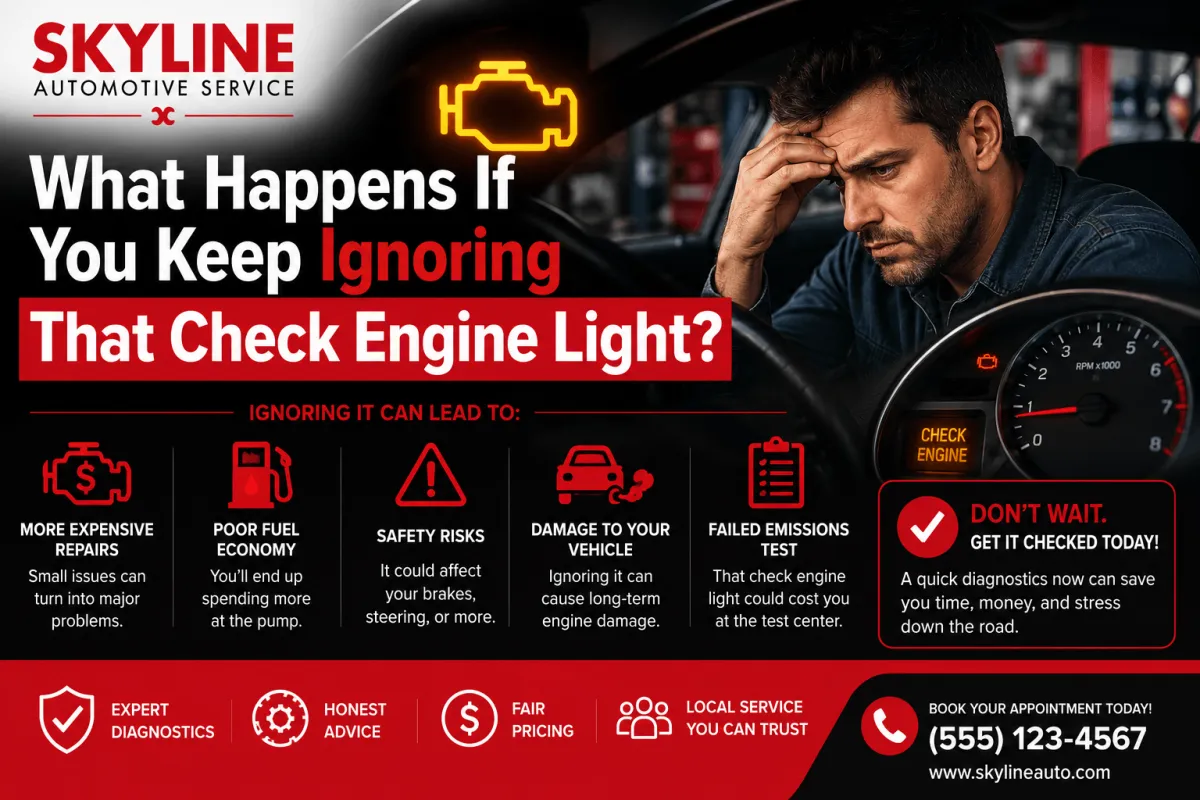
What Happens If You Keep Ignoring That Check Engine Light?
It starts as a small orange glow on your dashboard — easy to dismiss, easy to rationalize. The car drives fine. You have places to be. The light has been there for a week and nothing bad has happened yet. So you wait. And then you wait a little longer.
This is one of the most common and costly habits among drivers across Mississauga, ON and everywhere else. The check engine light is not a suggestion. It is your vehicle's way of telling you that something in its engine management system has flagged an abnormal condition — and the longer that condition goes unaddressed, the more likely it is to escalate into something far more serious and far more expensive.
What the Check Engine Light Actually Means
The check engine light — also called the malfunction indicator lamp, or MIL — is connected to your vehicle's onboard diagnostic system (OBD-II). When a sensor detects a reading outside of the normal operating range, it generates a fault code and triggers the light. That code is stored in the vehicle's computer and can be read with a diagnostic scanner.
The codes cover an enormous range of potential issues. Some are genuinely minor, like a loose gas cap allowing fuel vapour to escape from the evaporative emissions system. Others are serious — a misfiring cylinder, a failing oxygen sensor, a catalytic converter that is no longer functioning correctly, or a developing transmission issue. Without scanning the code, there is no way to know which category your light falls into.
What is important to understand is that the light itself does not tell you how urgent the issue is — but the underlying cause absolutely can be urgent. Drivers in Mississauga, ON who treat the check engine light as background noise are making a calculated gamble every time they start the car.
The Cascade: How Small Problems Become Major Repairs
Vehicle systems are interconnected. A problem in one component creates strain on the systems that depend on it, and that secondary strain eventually generates its own damage. Here is how ignoring a check engine light can set off a cascade of increasingly expensive consequences.
Oxygen Sensor Failure
A faulty oxygen sensor is one of the most common causes of a check engine light. The sensor itself costs $100 to $300 to replace. But if it goes unaddressed, the engine management system will run the engine with an incorrect fuel-to-air mixture. This wastes fuel — meaning you pay more at the pump — and causes the catalytic converter to work harder than it should. A catalytic converter replacement costs $800 to $2,500 or more, making a $150 sensor repair look like an obvious choice in hindsight.
Engine Misfires
A misfire code often indicates a failing spark plug, ignition coil, or fuel injector. These are typically low-to-moderate cost repairs when caught early. Left alone, a misfiring cylinder forces unburned fuel into the exhaust stream, which can overheat and destroy the catalytic converter. Worse, persistent misfires can cause scoring damage to cylinder walls, turning a $200 repair into an engine rebuild conversation.
Cooling System Issues
Some check engine codes relate to coolant temperature sensors or thermostat performance. If these are ignored and the cooling system develops a more serious fault — a failing water pump, a leaking radiator, a blown head gasket — the engine can overheat. In Mississauga, ON, where summer temperatures push engines harder, an overheated engine can warp the cylinder head, a repair that costs $1,500 to $4,000 or more.
What Driving with a Check Engine Light Can Cost You
The financial impact of ignoring the check engine light scales dramatically the longer you wait. Here is a realistic look at how costs can compound over time.
Week 1–2: Minor code, possible $50–$200 fix. Car drives normally.
Month 1–2: Secondary component begins to strain. Repair cost creeps to $300–$600.
Month 3–6: Damage reaches a third component. Costs can reach $800–$2,000.
Beyond 6 months: Catalytic converter, head gasket, or transmission damage in play. Costs of $2,000–$6,000+ become realistic.
These are not worst-case scare scenarios — they are patterns that certified mechanics see regularly at shops throughout Mississauga, ON.
The Emissions Test Problem
Ontario's Drive Clean program has evolved, but emissions-related issues flagged by a check engine light can still affect your ability to register your vehicle and pass required safety inspections. A vehicle with an active check engine light tied to emissions systems will fail certain inspection criteria. This is not just a financial inconvenience — in some cases it affects your ability to legally drive the vehicle.
If your vehicle is due for a safety inspection or you are planning to sell it, an active check engine light needs to be resolved. Clearing the code without fixing the underlying problem is not a solution — most modern vehicles will re-trigger the light within a short drive cycle.
Frequently Asked Questions
Can I drive my car if the check engine light is flashing instead of steady?
A flashing check engine light is more urgent than a steady one. It typically indicates an active misfire that is severe enough to damage the catalytic converter in real time. Pull over when it is safe to do so and have the vehicle towed or driven very gently to a shop immediately.
If I clear the code myself with an OBD reader, does that fix the problem?
No. Clearing the code removes the stored fault and turns off the light, but the underlying condition that triggered it remains. The code will return — usually within a few drive cycles. Clearing codes without repairing the fault can also reset the vehicle's readiness monitors, which may cause it to fail an emissions or safety inspection.
How much does a diagnostic scan cost at a shop?
Most shops in Mississauga, ON charge between $80 and $150 for a diagnostic scan and assessment. This fee is typically applied toward the repair cost if you authorize the work. Some auto parts stores offer free code reading, but they provide the raw code only — not the diagnosis of what is actually causing it.
Can a check engine light affect my fuel economy?
Yes. Many of the issues that trigger the check engine light — oxygen sensor faults, misfires, throttle position sensor problems — directly affect how efficiently the engine burns fuel. Drivers often notice a measurable drop in fuel economy before they become aware of other symptoms.
Is it possible for the check engine light to come on and then go off on its own?
Yes, under certain circumstances. If the condition that triggered the light resolves itself — for example, a temporary sensor glitch — the light may go off after a few drive cycles without the code ever being addressed. However, the fault code is still stored in the vehicle's memory for a period of time. A mechanic can retrieve it even if the light is currently off.
Conclusion
The check engine light is not something your car invented to stress you out. It exists because the engineers who built your vehicle understood that early warning is always better than emergency intervention. Every day the light stays on without being investigated is a day a small, manageable issue has the potential to grow into a much larger one.
Mississauga, ON drivers who bring their vehicles to Skyline Automotive Service can count on a fast, thorough diagnostic process, plain-English explanations of what the codes mean, and honest recommendations about what genuinely needs to be done. Do not wait for a warning light to become a breakdown. Book a diagnostic appointment today.
