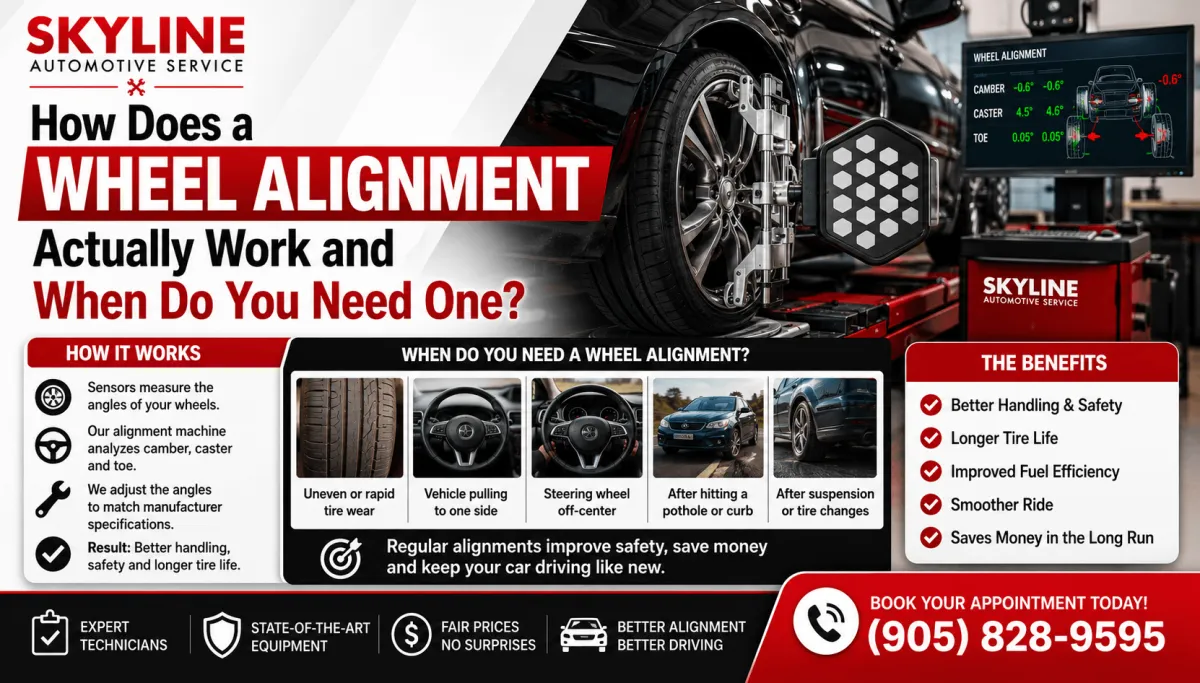
How Does a Wheel Alignment Actually Work and When Do You Need One?
Wheel alignment is one of those services that gets recommended regularly but rarely explained. Drivers in Mississauga, ON hear it mentioned at tire shops, oil change centres, and during routine inspections — but most leave without a clear understanding of what was actually done to their vehicle or why it matters. That knowledge gap costs money, because without understanding what alignment does, it is easy to either skip it when it is genuinely needed or pay for it when the timing is not right.
This guide explains the mechanics behind wheel alignment, what goes wrong when it is off, how the service is actually performed, and how to know when your vehicle genuinely needs it.
What Wheel Alignment Actually Is
Wheel alignment refers to the adjustment of the angles at which your tires make contact with the road. These angles are set by the vehicle manufacturer to specific parameters that balance steering precision, tire longevity, and fuel efficiency. Over time, and especially after significant road impacts, those angles can shift — and when they do, the effects on your vehicle are measurable.
Alignment is measured and adjusted across three primary angles. Understanding these gives you a much clearer picture of what a technician is actually doing during a wheel alignment service.
Camber
Camber is the inward or outward tilt of the tire when viewed from the front of the vehicle. A tire that tilts outward at the top has positive camber; inward tilt is negative camber. Most vehicles are designed for a slight negative camber to improve handling under load. Excessive camber in either direction causes the tire to wear unevenly on one edge.
Toe
Toe describes whether the fronts of the tires point inward (toe-in) or outward (toe-out) relative to each other. This is the most commonly adjusted alignment parameter and has the most immediate effect on tire wear. Even a small toe misalignment causes tires to scrub sideways as the vehicle moves forward, wearing the tread surface rapidly in a feathered pattern.
Caster
Caster is the angle of the steering axis relative to vertical when viewed from the side of the vehicle. It affects steering stability and return-to-centre behaviour. Most modern vehicles have positive caster, which contributes to straight-line tracking and steering feel. Caster is less frequently out of spec but becomes relevant after front-end damage or significant suspension component wear.
How a Wheel Alignment Is Performed in Mississauga, ON
A professional wheel alignment is a precise, equipment-dependent process. Here is what happens step by step when you bring your vehicle in for this service.
The vehicle is driven onto an alignment rack and the tires are placed on turntables and slip plates that allow each wheel to move independently.
Sensors or targets are clamped to each wheel and connected to the alignment machine, which measures the current angles with millimetre precision.
The technician compares the measured angles against the manufacturer's specified range for that vehicle.
Any angles outside of specification are adjusted using adjustment bolts, eccentric cams, or shims depending on the vehicle's suspension design.
After adjustments, the machine re-reads all angles and confirms they fall within the acceptable range.
A printed alignment report is generated showing before-and-after measurements — a document you should always ask to receive.
Signs Your Vehicle Needs a Wheel Alignment
Your vehicle will usually tell you when the alignment has shifted. The following signs are reliable indicators that it is time to have the angles checked.
Pulling to one side: If your car drifts left or right when you release the steering wheel on a flat road, toe or caster misalignment is the likely cause.
Uneven tire wear: Wear concentrated on the inside or outside edge of a tire, or a feathered/sawtooth wear pattern across the tread, strongly suggests an alignment issue.
Off-centre steering wheel: If the steering wheel is not centred when driving straight, the alignment needs attention.
Vibration in the steering wheel: While this can have other causes, alignment-induced tire wear often creates the kind of imbalance that results in vibration at highway speeds.
After hitting a significant pothole or curb: A hard impact can shift alignment angles immediately. Mississauga, ON roads — especially after harsh winters — can deliver impacts forceful enough to knock alignment off in a single hit.
How Often Should You Get a Wheel Alignment?
Most manufacturers recommend a wheel alignment check once per year or every 20,000 to 25,000 kilometres under normal driving conditions. However, specific circumstances in Mississauga, ON make more frequent checks worthwhile. Drivers who regularly encounter the significant potholes common on Ontario roads after freeze-thaw cycles, those who have recently replaced suspension or steering components, or those whose tires are showing any sign of uneven wear should prioritize an alignment check regardless of where they fall in the mileage calendar.
A common practical approach is to have alignment checked every time new tires are installed. Putting new tires on a misaligned vehicle is an expensive mistake — the tires will begin wearing unevenly immediately, reducing their lifespan significantly.
Frequently Asked Questions
Is wheel alignment the same as wheel balancing?
No — these are two different services often confused with each other. Wheel alignment adjusts the angles at which tires contact the road. Wheel balancing corrects weight imbalances around the circumference of the wheel and tire assembly. Both affect ride quality and tire wear, but they address different issues and require different equipment.
Can I visually tell if my alignment is off?
Not reliably. The angles involved are measured in fractions of a degree, and even significant misalignment is rarely visible to the naked eye. The symptoms — pulling, uneven wear, an off-centre wheel — are more reliable indicators than visual inspection. A proper measurement requires alignment equipment.
Will a wheel alignment fix my steering wheel vibration?
It depends on the cause of the vibration. If the vibration is caused by uneven tire wear that resulted from alignment issues, correcting the alignment will stop further uneven wear but will not restore a tire that has already worn unevenly. Tires with significant uneven wear typically need to be replaced. If the vibration is caused by wheel imbalance, balancing is the appropriate service.
How long does a wheel alignment take?
A standard four-wheel alignment typically takes 60 to 90 minutes at a properly equipped shop. If suspension or steering components are worn and need replacement before alignment can be completed accurately, the appointment will take longer. It is best to ask for a time estimate when booking.
Is a two-wheel alignment ever sufficient, or is four-wheel always necessary?
Vehicles with a solid rear axle — some trucks and older vehicles — may only require a front-wheel (two-wheel) alignment. Most modern passenger vehicles with independent rear suspension require a four-wheel alignment to achieve accurate results. Your mechanic can advise which type applies to your vehicle based on its suspension design.
Conclusion
Wheel alignment is not a mysterious black box — it is a precise, measurable adjustment that has a direct and significant impact on how your tires wear, how your car handles, and how much fuel it uses over time. Understanding the three alignment angles, knowing the signs that your alignment has shifted, and getting the service done at the right intervals puts you in control of one of the most cost-effective maintenance decisions you can make.
Skyline Automotive Service in Mississauga, ON performs computerized wheel alignments with printed before-and-after reports so you can see exactly what was found and corrected. If your vehicle is pulling, wearing unevenly, or due for a tire change, book an alignment check and protect your investment in your tires.
